Fire Risk Assessments for Offices, Retail and Residential Buildings
What’s involved, what the law requires, and why the competence of your assessor matters
By Rob Anderson CMIOSH MIFSM, Complisafe | Fire Safety | November 2026
If you own, manage or occupy an office, a shop or a residential building with shared common parts, you almost certainly have a legal duty to make sure a suitable and sufficient fire risk assessment is in place. Since October 2023 that assessment must be recorded in full, and the fines for getting it wrong are now unlimited.
Yet fire risk assessment is still widely misunderstood. It is sometimes treated as a tick-box exercise, carried out once and filed away, or bought on price from whoever is cheapest. A fire risk assessment is only as good as the person who carries it out and the actions that follow it.
In this article we explain how Complisafe approaches fire risk assessment, what the process involves, what information we need from you, the legal framework, and how to check that your assessor is genuinely competent. We give particular attention to offices, retail premises and residential buildings, three sectors we work in every week across London and the South East.
Why fire risk assessment matters: the numbers
The latest official figures for England, covering April 2025 to March 2026, show that fire remains a significant and persistent risk to buildings and the people in them.
| 170,597 fires attended (up 19%) | 26,180 dwelling fires | 13,679 other building fires | 254 fire-related deaths |
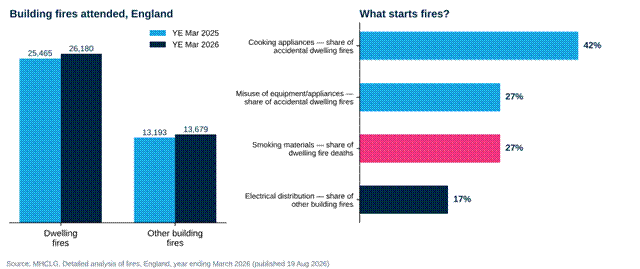
Figure 1: Building fires and leading ignition sources in England. Source: MHCLG, Detailed analysis of fires, year ending March 2026.
Two findings stand out for the sectors covered in this article. In non-residential buildings such as offices and shops, electrical distribution was the largest specified ignition source, at 17% of fires. In homes, cooking appliances caused 42% of accidental dwelling fires, while smoking materials caused 7.6% of those fires but 27% of dwelling fire deaths. A good fire risk assessment targets exactly these kinds of hazards.
What is a fire risk assessment?
A fire risk assessment is a careful look at your premises and the people who use them, from a fire prevention perspective. It identifies what could cause a fire, who would be at risk, and whether the measures in place are adequate, then sets out what needs to improve. The output must be a written record.
At Complisafe, every assessment looks at three areas:
- The premises: a non-destructive inspection of the layout, escape routes, equipment, compartmentation, fire doors, alarm and detection, emergency lighting, signage, and how checks and maintenance are carried out.
- The people: who uses the building and when, including anyone at particular risk, such as visitors unfamiliar with the layout, lone workers, sleeping residents and people with disabilities, and how they would be warned and evacuated.
- Fire prevention and protection measures: the hazards present, how they are removed or controlled, and the physical and management arrangements that protect people if a fire does start.
Our approach to fire risk assessment
We have built our approach on a simple principle: an assessment should be practical, proportionate and easy to act on. We are not interested in producing a thick report that sits on a shelf. We want you to finish with a clear understanding of your risks and a prioritised list of what to do about them.
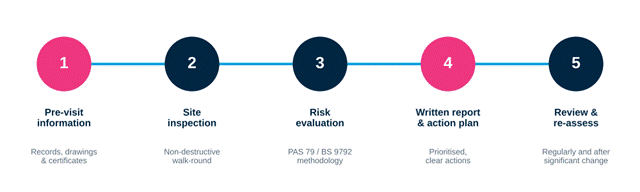
Figure 2: The Complisafe fire risk assessment process
1. Pre-visit information
Before we visit, we ask for the records and documents that tell us how your building is managed (see the checklist below). This lets us spend our time on site looking at the things that matter, and it often highlights gaps before we arrive.
2. Site inspection
A competent assessor carries out a thorough, non-destructive walk-round of the premises. We look at your activities, equipment, maintenance, training, compartmentation and alarm systems. A representative who knows the building should show us around and answer questions, as their knowledge of day-to-day operation is invaluable.
3. Risk evaluation
Our assessors work to recognised methodologies: PAS 79 for non-domestic premises and BS 9792:2025, the code of practice for housing. This gives a structured, consistent and defensible assessment that enforcing authorities, insurers and lawyers recognise.
4. Written report and prioritised action plan
You receive a clear PDF report with a prioritised action plan. Each recommendation is linked to a finding, so you know what needs doing, why, and how urgently. Our reports cover:
| Report section | What it covers |
| Introduction & regulatory requirements | Scope, the Responsible Person, the legislation that applies |
| Premises & occupants | Building description, use, occupancy, people especially at risk |
| Fire loss experience & other legislation | Previous incidents, related duties and interfaces |
| Fire hazards & their control | Ignition sources, fuel, oxygen, arson risk, housekeeping |
| Fire protection measures | Escape routes, compartmentation, fire doors, alarm, lighting, signage, firefighting equipment |
| Management of fire safety | Procedures, training, drills, testing, maintenance and records |
| Risk evaluation & action plan | Overall risk rating with prioritised, practical actions |
5. Review and re-assess
A fire risk assessment is a living document. It must be reviewed regularly and whenever there is a significant change, such as a refit, a change of use or occupancy, new processes or equipment, or a fire or near miss. We can carry out reviews quickly when your circumstances change.
| IMAGE PLACEHOLDER Complisafe assessor inspecting fire safety equipment complisafe.co.uk/wp-content/uploads/2024/03/health-safety-fire-risk-assessment-1024×683.jpeg |
What information do we need from you?
Having the following information ready helps us complete a thorough assessment efficiently. Don’t worry if you can’t find everything. Gaps are common, and identifying them is part of what the assessment is for.
| Building & systems | Management & people |
| Fire alarm test and service records | Written fire procedures and emergency plan |
| Emergency lighting test and service records | Fire log book |
| Fire extinguisher service records | Fire warden and fire awareness training records |
| Fixed electrical wiring (EICR) and PAT records | Fire drill records |
| Gas safety and HVAC maintenance records | PEEPs and GEEPs for people who need help to evacuate |
| Compartmentation / fire-stopping certification | Contractor management and permit-to-work arrangements |
| Sprinkler or suppression system information | Staff induction records |
| Smoke ventilation (AOV) details | Previous fire risk assessments and action status |
| Fire safety signage and floor plans | Details of other Responsible Persons in the building |
The benefits of a professional fire risk assessment
The legal duty is the obvious reason to carry out a fire risk assessment, but it is far from the only one.
- It protects lives. Above all, an assessment makes sure people can be warned and can escape safely if a fire starts.
- It keeps you legally compliant. A suitable and sufficient, fully recorded assessment is your primary evidence that you have met your duties under the Fire Safety Order.
- It protects your business. A fire can close a business permanently. Good prevention gives you the best chance of avoiding a fire, and of continuing to trade if one happens.
- It satisfies third parties. Insurers, landlords, managing agents, the fire and rescue service and property lawyers all expect to see a current fire risk assessment.
- It saves money. A prioritised action plan focuses spend where it reduces risk the most and avoids unnecessary works.
- It builds confidence. Staff, customers, residents and tenants feel safer when fire safety is visibly well managed.
The legal framework
In England and Wales, fire safety in non-domestic premises, and in the common parts of residential buildings, is governed by the Regulatory Reform (Fire Safety) Order 2005 (the Fire Safety Order). It places duties on the Responsible Person: usually the employer, and/or the owner, landlord or person who controls the premises. A building can have more than one Responsible Person, and they must co-operate and share information.
The law has changed significantly in recent years, largely in response to the Grenfell Tower tragedy:
| Legislation | In force | Key effect |
| Regulatory Reform (Fire Safety) Order 2005 | Oct 2006 | Duty to carry out and act on a suitable and sufficient fire risk assessment, and to review it regularly |
| Fire Safety Act 2021 | 16 May 2022 | Confirms the Order covers the structure, external walls (including cladding, balconies and windows) and flat entrance doors of multi-occupied residential buildings |
| Fire Safety (England) Regulations 2022 | 23 Jan 2023 | New duties for multi-occupied residential buildings, including resident fire safety information and, above 11m, quarterly communal fire door checks and annual flat entrance door checks |
| Building Safety Act 2022, section 156 | 1 Oct 2023 | Fire risk assessments and fire safety arrangements must be recorded in full for all premises; the assessor’s identity must be recorded; co-operation duties strengthened; unlimited fines for more offences |
| What this means in practice Every premises needs a written record. The old exemption for businesses with fewer than five employees has gone. Every Responsible Person must record the fire risk assessment in full, including all of its findings. Your assessor must be named. The record must include the identity of anyone appointed to help carry out or review the assessment. Penalties are serious. Following section 156, certain offences under Article 32 now carry unlimited fines rather than a maximum of £1,000. The most serious breaches can lead to imprisonment. Competence is heading into law. Section 156(4) will insert a new Article 9A requiring Responsible Persons to appoint only competent fire risk assessors. As of September 2026 it had not yet been brought into force, but the direction of travel is clear, and appointing a competent assessor is already your best evidence of due diligence. |
Sector focus: offices, retail and residential
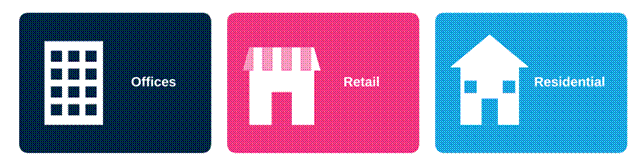
Every building is different, but each of these sectors brings its own typical risks. Our assessors are experienced across all three and tailor every assessment to the building and how it is used.
Office fire risk assessments
Offices are often considered low risk, and many are. That perception can lead to complacency, particularly in multi-let buildings and older stock that has been refitted many times.
What we typically focus on in offices:
- Electrical safety: overloaded extension leads, daisy-chained adaptors, under-desk heaters, comms and server rooms, and charging of laptops, phones and e-bikes or e-scooters with lithium-ion batteries.
- Compartmentation after refits: new cabling and services routed through fire-resisting walls and ceilings without proper fire-stopping.
- Fire doors: wedged open, damaged, or with missing or ineffective self-closers, smoke seals or signage.
- Multi-tenant buildings: co-ordination between landlord and tenants, compatible evacuation procedures and clear responsibility for common parts.
- Hybrid working: making sure there are enough trained fire wardens on site on any given day, not just on paper.
- Evacuation of people who need help: PEEPs, refuge areas and evacuation lift arrangements in taller buildings.
- Kitchens and tea points: toasters, microwaves and housekeeping.
Retail fire risk assessments
Shops combine members of the public who don’t know the building, often high fire loads, and staff who may be new, part-time or seasonal. That combination makes good fire safety management critical.
What we typically focus on in retail premises:
- Escape routes and fire exits: kept clear of deliveries, stock, cages and display units, especially during peak trading periods such as Christmas.
- Stockrooms and storage: high fire loading, stacking heights, storage near ignition sources and unprotected upper-floor or mezzanine storage.
- Arson prevention: packaging and waste bins stored against the building, rear-yard security and out-of-hours protection.
- Staff training: making sure every shift, including new starters and temporary staff, knows how to raise the alarm and help customers out.
- Shopping centres and parades: interfaces with centre management, shared alarm systems and evacuation strategies, and flats above shops.
- Electrical equipment: lighting, signage, tills, chargers and display equipment.
Residential fire risk assessments
For blocks of flats, converted houses, HMOs and other buildings with two or more homes, the Fire Safety Order applies to the common parts and, since the Fire Safety Act 2021, to the building’s structure, external walls and flat entrance doors. This area has seen the most change in fire safety law in recent years.
What we typically focus on in residential buildings:
- The evacuation strategy: whether a “stay put” or simultaneous evacuation strategy is appropriate, and whether the building’s construction and condition actually support it.
- Flat entrance doors and communal fire doors: condition, self-closers, smoke seals, glazing and any replacements that may not be fire-resisting.
- Compartmentation: visible breaches in common parts, service risers, meter cupboards and roof voids.
- External walls: a fire risk assessor-level view of external wall construction, and a recommendation for specialist appraisal where it is needed.
- Common parts management: storage, mobility scooters, e-bikes, bins and items left in corridors and stairways.
- Resident information: fire safety instructions and fire door information that the Fire Safety (England) Regulations 2022 require for all multi-occupied residential buildings.
- Height-related duties: above 11m, quarterly checks of communal fire doors and best-endeavours annual checks of flat entrance doors; above 18m, further duties such as secure information boxes, wayfinding signage and sharing building information with the fire and rescue service.
Residential assessments are normally non-destructive and cover the common parts (a “Type 1” assessment). Where the findings justify it, we will advise whether a more intrusive or extended assessment is needed.
Sector comparison at a glance
| Offices | Retail | Residential | |
| Typical occupants | Staff and visitors, generally awake and familiar with the building | Members of the public unfamiliar with the layout, and a changing staff team | Residents, often asleep, including vulnerable people |
| Common hazards | Electrical equipment, lithium-ion charging, kitchens | High fire loads, stock storage, arson, blocked exits | Cooking, smoking, e-bikes, items stored in common parts |
| Key focus areas | Compartmentation after refits, fire wardens, multi-tenant co-ordination | Escape routes, staff training, storage and housekeeping | Evacuation strategy, fire doors, compartmentation, external walls |
| Recent legal change | Section 156: full written record and co-operation | Section 156: full written record and co-operation | Fire Safety Act 2021, Fire Safety (England) Regulations 2022 and section 156 |
The competency of our fire risk assessors
The government recommends that Responsible Persons use a suitably qualified, competent fire professional to carry out their fire risk assessment. A poor assessment can be worse than none at all: it gives false reassurance, misses significant hazards and leaves you exposed if something goes wrong.
Competence is now defined more clearly than ever. BS 8674:2025, published in August 2025, sets out a framework for what competence means for a fire risk assessor. Independent registers allow you to check an assessor’s competence before you appoint them.
The National Fire Risk Assessors Register (NFRAR)
The Institute of Fire Safety Managers (IFSM) is a professional body dedicated to advancing fire safety at local, national and international levels. In late 2025 the IFSM’s Tiered Fire Risk Assessors Register officially became the National Fire Risk Assessors Register (NFRAR), a public directory that gives Responsible Persons assurance when appointing a fire risk assessor.
NFRAR has three levels, each matched to the complexity of the buildings an assessor is competent to assess:
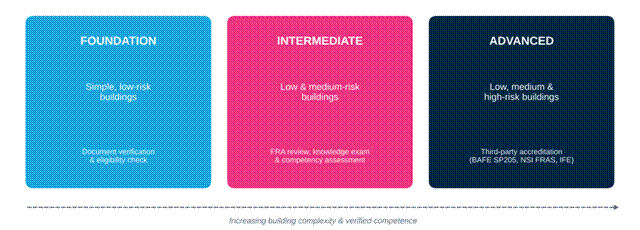
Figure 3: NFRAR competency levels. Source: IFSM, NFRAR Policy (018A) v23
| Level | Competent to assess | How competence is verified |
| Foundation | Simple, low-risk buildings | Recognised qualification (e.g. ABBE Level 2 Certificate), document verification and eligibility check |
| Intermediate | Low and medium-risk buildings | At least two years’ FRA experience; review of recent FRAs on medium-risk buildings of different types; knowledge-based exam or assignment; two-yearly competency review |
| Advanced | Low, medium and high-risk buildings | Review of FRAs on high-risk buildings plus active third-party accreditation (BAFE SP205, NSI FRAS or IFE with Engineering Council registration) |
At every level, registrants must maintain a record of fire-specific continuing professional development (CPD), with at least 30 points in the previous 12 months on renewal.
| IMAGE PLACEHOLDER NFRAR Intermediate Level badge complisafe.co.uk/wp-content/uploads/2026/01/NFRAR-Intermediate-Level-Badge-3-768×356.webp |
Complisafe’s credentials
Complisafe is registered on the NFRAR at Intermediate Level. This means our fire risk assessment work has been independently reviewed and our knowledge tested by the IFSM, and we are verified as competent to assess low and medium-risk buildings, which covers the great majority of offices, shops and residential blocks.
Complisafe is led by Rob Anderson CMIOSH MIFSM, a Chartered Member of IOSH and a Member of the Institute of Fire Safety Managers, with more than 25 years’ experience in health and safety. Our wider accreditations include:
| NFRAR Intermediate Level | OSHCR Registered consultant | IOSH Chartered member | CHAS / SSIP Verified supplier | CMaPS Certified |
| 25+ years’ experience | 250+ clients nationwide | 6+ sectors served |
| Questions to ask any fire risk assessor before you appoint them Are you on a recognised register such as NFRAR, and at what level?Is that level right for the type and complexity of my building?What experience do you have of buildings like mine?Which methodology do you follow (e.g. PAS 79 or BS 9792)?How do you keep your knowledge up to date?What will the report look like, and will I get a prioritised action plan? |
Frequently asked questions
How often should a fire risk assessment be reviewed?
The law requires the assessment to be reviewed regularly so that it stays up to date, and whenever there is reason to think it is no longer valid, for example after building works, a change of use or occupancy, or a fire. As a rule of thumb many premises are reviewed annually, with higher-risk buildings reviewed more often. Your assessment will state a recommended review date.
Can I do my own fire risk assessment?
For a small, simple premises a Responsible Person with enough training and knowledge can carry out their own assessment, and government guides are available. For most businesses, multi-occupied buildings and anything other than the simplest premises, a professional assessor is strongly recommended. The assessor must be competent, and you must be able to show you took reasonable steps to check that.
Do I need a fire risk assessment for a block of flats?
Yes. The Fire Safety Order applies to the common parts of any building containing two or more homes and, since 2022, to the structure, external walls and flat entrance doors. Additional duties apply under the Fire Safety (England) Regulations 2022, depending on the building’s height.
How long does an assessment take?
That depends on the size and complexity of the premises. A small shop or office suite can often be inspected in a couple of hours, while a large multi-storey building can take a day or more. We will give you a clear timescale and quote before we start.
Do you cover my area?
We are based in Croydon and carry out fire risk assessments across London and the South East, with short-notice bookings available.
| Book your fire risk assessment Whether you manage an office, a shop or a residential block, our NFRAR-registered assessors will give you a clear, practical assessment and a prioritised action plan you can act on. 0333 577 2700 | info@complisafe.co.uk complisafe.co.uk/contact |
Sources and further reading
- Complisafe, Fire Risk Assessments — complisafe.co.uk/services/fire-risk-assessments/
- IFSM, NFRAR Policy 018A v23 — ifsm.org.uk/wp-content/uploads/018A-National-Fire-Risk-Assessors-Register-Policy-V23.pdf
- IFSM, Launch of the National Fire Risk Assessors Register — ifsm.org.uk/news-bulletins/launch-of-the-institutes-national-fire-risk-assessors-register/
- National Fire Risk Assessors Register — nfrar.co.uk/
- MHCLG, Detailed analysis of fires, England, year ending March 2026 — www.gov.uk/government/statistics/detailed-analysis-of-fires-england-year-ending-march-2026
- GOV.UK, Fire safety responsibilities under Section 156 of the Building Safety Act 2022 — www.gov.uk/government/publications/check-your-fire-safety-responsibilities-under-section-156-of-the-building-safety-act-2022
- GOV.UK, Fire Safety (England) Regulations 2022: fact sheet — www.gov.uk/government/publications/fire-safety-england-regulations-2022/fact-sheet-overview